 blog
Secure Storage for Small Flats: Coventry Guide
Table of Contents
- What Secure Storage for Small Flats in Coventry Actually Involves
- Storage Unit Sizes: Matching Your Flat's Contents to the Right Space
- Security Features That Matter in a Storage Facility
- Short Term Storage Rental: Contracts That Fit Real Life
- Moving Company Insurance Coverage Explained
- How to Pack for Long Term Storage Without Ruining Your Belongings
- Costs, Contracts and What to Ask Before You Book
- Frequently Asked Questions
Last Updated: September 22, 2026
What Secure Storage for Small Flats in Coventry Actually Involves
Secure storage for small flats in Coventry is the practice of housing your possessions in a monitored, access-controlled facility when your flat cannot hold everything you own. It matters most during moves, downsizing, and the gaps between tenancies. This guide from Fletcher Removals and Storage covers unit sizes, security features, contract terms, insurance, and packing methods so you can book with confidence.
Small flats create a specific problem. You have nowhere to put the contents of a one-bedroom flat while you decorate, wait for completion, or downsize. A spare room is not an option. A friend's garage is not secure.
That is where professional storage earns its place. The right facility keeps your belongings dry, monitored, and insured until you need them again.
Below, we break down exactly what to check before you sign anything, from unit dimensions to the small print on short term storage rental.
Storage Unit Sizes: Matching Your Flat's Contents to the Right Space
Storage units are sized in square feet or square metres, and most facilities offer a standard ladder of options. The smallest units suit a few boxes. The largest hold the entire contents of a flat. Matching your belongings to the right size saves money and avoids wasted space.
Here is how the common sizes map to real flat contents:
| Unit Size | Roughly Holds | Best For |
|---|---|---|
| 10 sq ft | 10-15 boxes, a chair | Students, decluttering |
| 25 sq ft | Studio flat contents | Single occupants, short moves |
| 50 sq ft | One-bedroom flat | Couples, six-week gaps |
| 75 sq ft | Two-bedroom flat | Families, furniture sets |
| 100+ sq ft | Three-bedroom house | Full house moves |
Working Out What You Own Before You Book
Measure before you commit. Most people overestimate how much space they need, then pay for a unit that sits half empty.
Walk through your flat room by room and list the bulky items first: sofas, beds, wardrobes, white goods. These dictate the unit size far more than boxes do.
A common mistake is booking the smallest unit to save money, then discovering the sofa will not fit through the door. Ask about door dimensions and ceiling height, not just floor area. If you are unsure, most facilities will let you view a unit before booking.
Security Features That Matter in a Storage Facility
Security is the whole point of paying for storage, so check what actually protects your belongings rather than what the brochure claims. Three things matter most: physical access control, monitoring, and who holds the keys.
Look for these features before you book:
- 24-hour CCTV covering entrances, corridors, and unit doors
- Individual unit locks where you keep the only key
- PIN or fob entry so every visit is logged
- On-site staff during opening hours
- Perimeter fencing and lighting for outdoor compounds
Access Control and Monitoring
Access control determines who can reach your unit. The strongest setups combine a unique code per customer with staff who know the site. Weak setups rely on a shared gate code that gets passed around.
Ask directly: is the site staffed, and are there alarms on individual units? A facility with good cameras but no staff presence overnight is still vulnerable.
Short Term Storage Rental: Contracts That Fit Real Life
Short term storage rental is a flexible agreement, usually week to week or month to month, that lets you store belongings for a defined period without a long commitment. It suits people between tenancies, renovating, or waiting on a house purchase.
The key question is minimum term. Some providers insist on a set number of weeks. Others charge a premium for the flexibility of leaving at short notice.
Before signing, confirm:
- The minimum rental period and notice required to leave
- Whether you pay weekly or monthly, and in advance or arrears
- Any admin or deposit fees on top of the rent
- What happens if you need to extend
If you are between places for around six weeks, a rolling monthly contract usually fits better than a fixed term. Ask what notice you must give, and get it in writing.
Moving Company Insurance Coverage Explained
Moving company insurance coverage explained simply: it is the protection a removals firm carries to cover your goods while they are in transit and stored. Two types matter most, and they cover different things.
Goods in Transit insurance covers your belongings while they are being moved between addresses. Public Liability insurance covers injury to people or damage to property caused by the company during the job.
These are not the same as your own contents insurance. Check whether your home policy extends to items in storage. Many do not, or only for a limited period.
Fletcher Removals and Storage carries both Goods in Transit and Public Liability insurance.
How to Pack for Long Term Storage Without Ruining Your Belongings
How to pack for long term storage comes down to three rules: clean and dry, protect fragile items, and label everything. Damp and pests cause more damage in storage than knocks do. Preparation before the boxes go in prevents most of it.
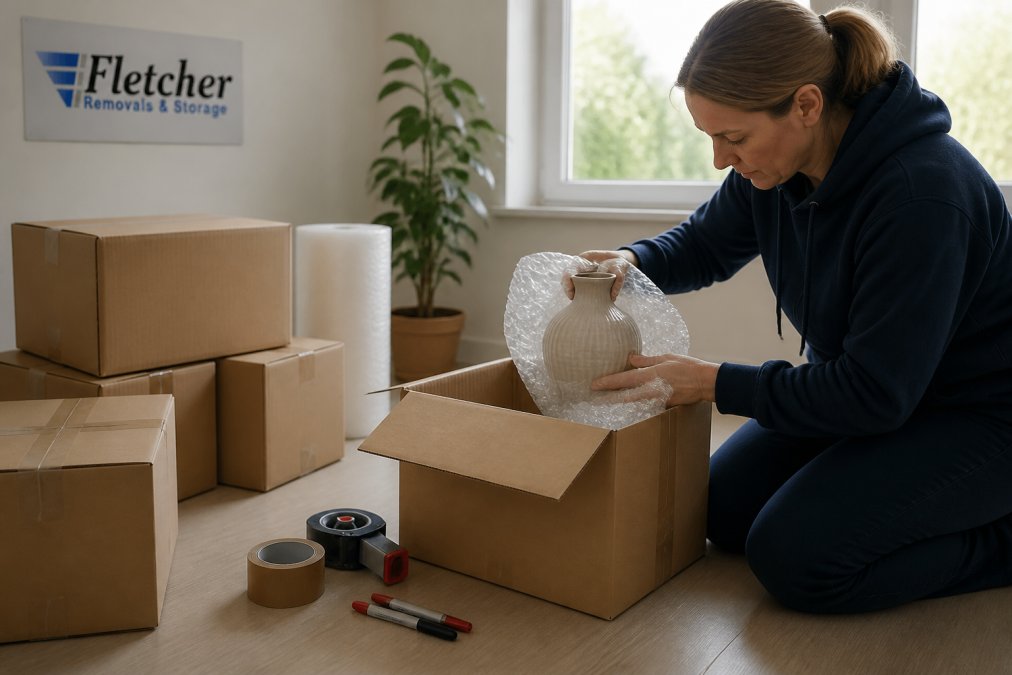
Work through this checklist before your items leave the flat:
- Clean and fully dry every item, especially kitchenware
- Wrap fragile pieces individually in bubble wrap or tissue
- Use sturdy double-walled boxes for heavy items
- Fill gaps in boxes so contents cannot shift
- Label each box with contents and the room it belongs to
- Keep screws and fittings in a labelled bag taped to the furniture
- Avoid sealing damp or dirty items in plastic, which traps moisture
For antique furniture, wrap in breathable covers rather than plastic sheeting. Plastic traps condensation and can mark finishes over months in storage. If you are unsure about a fragile piece, ask the removals team to pack it for you.
Costs, Contracts and What to Ask Before You Book
Storage pricing depends on unit size, duration, and location, so no single figure applies to everyone. Rather than quote a number that will not match your situation, it is worth understanding what drives the cost and what to confirm before you commit.
Costs typically rise with unit size and fall with longer commitments. Short notice periods and flexible contracts often carry a small premium. Ask for a full breakdown so nothing appears on the final invoice that you did not agree to.
Questions worth asking every provider:
- What is included in the quoted price, and what costs extra?
- Is there a deposit, and when is it returned?
- What notice do I give to end the contract?
- Are my goods insured while stored, and up to what limit?
- Can I access my unit outside office hours?
Fletcher Removals and Storage offers transparent pricing with no hidden fees, along with onsite warehouse storage (container and self-storage). Whether you have a single flat's worth of belongings or a full house to store, the team treats every job with the same care.
Moving out of a small flat brings a familiar squeeze: too much to carry, nowhere to put it, and a deadline you cannot move. Fletcher Removals and Storage handles the whole job, from trained, uniformed staff who pack and dismantle your furniture to secure onsite storage that keeps everything safe until your new place is ready. With Goods in Transit and Public Liability insurance and transparent pricing, you know exactly what you are getting. Get started with Fletcher Removals and Storage and take the pressure out of your next move.
Frequently Asked Questions
How much does secure storage cost for a small flat?
Pricing depends on the size of unit you need, how long you're storing items, and whether you want a container or self-storage option. A one-bedroom flat's contents typically need less space than a three-bedroom house, so costs vary widely. Rather than quoting a figure that won't match your situation, it's best to ask for a personalised quote based on your actual inventory and storage duration. Most providers, including Fletcher Removals and Storage, offer transparent pricing with no hidden fees.
What security features should I look for in a storage unit?
Look for a facility with controlled access, CCTV monitoring, and staff on site during operating hours. Alarmed premises and individual unit locks add another layer of protection. If you're storing valuable or antique items, ask whether the provider carries Goods in Transit and Public Liability Insurance, as this covers your belongings while they're being moved and stored.
Are there flexible storage contracts for short term storage rental?
Yes. Many providers offer rolling monthly agreements rather than locking you into a long fixed term. This suits people between properties, those waiting for a completion date, or anyone needing storage for just a few weeks. Ask upfront whether there's a minimum period, how much notice you need to give before moving out, and whether the rate changes after an introductory period. Flexible terms matter most when your timeline is uncertain.
Is my stored property covered by insurance?
It depends on the provider. Reputable moving companies carry Goods in Transit Insurance, which covers your items while they're being transported, and Public Liability Insurance, which covers damage on premises. Ask to see exactly what's covered, what the excess is, and whether there are limits per item. If you're storing high-value items like antiques or electronics, check whether you need additional cover. Get the insurance details in writing before you sign anything.