 how-to
Why Business Inventory Storage Needs Climate Control
Table of Contents
- Why Business Inventory Storage Needs Climate Control: The Risks You Can't Ignore
- What Items Need Climate-Controlled Storage
- Ambient Versus Climate-Controlled Warehousing: What's the Real Difference
- How Damp and Temperature Changes Damage Stored Stock
- How to Protect Stock in Storage: Practical Steps for Business Owners
- What Temperature and Humidity Should Business Inventory Be Stored At
- Is Climate-Controlled Storage Worth the Extra Cost for a Business
- How to Tell Whether a Storage Unit Has Suitable Climate Control
- Frequently Asked Questions
Last Updated: 12 October 2026
Why Business Inventory Storage Needs Climate Control: The Risks You Can't Ignore
Damp, heat and cold quietly destroy stock. That is the short answer to why business inventory storage needs climate control: paper cockles, cardboard softens, adhesives fail, metals corrode and mould spreads, often before anyone notices. This guide from Fletcher Removals and Storage explains what climate control actually does, which stock needs it most, and how to check a unit before you sign.
Most owners only find the problem when a customer opens a box and finds ruined goods. By then the loss is done.
Below, we cover the items most at risk, the real difference between ambient and controlled space, and the practical steps that protect stock.

What Items Need Climate-Controlled Storage
Anything made of paper, fabric, wood, leather, metal or food needs climate-controlled storage. These materials absorb moisture from the air and react to heat, so they shift, warp, rust or spoil when conditions swing.
Some stock survives ambient space. Durable plastics, sealed tins and most glassware cope with normal temperature changes. But mixed stock is the norm for most small firms, and one sensitive pallet can spoil a whole bay.
Stock That Suffers Most from Damp and Temperature Swings
- Paper and packaging: boxes lose strength, labels peel, print smudges
- Textiles and upholstery: damp causes musty smells and mould spots
- Wooden furniture: joints loosen and veneers lift in dry heat
- Leather goods: cracks in low humidity, grows mould in high humidity
- Electronics: condensation inside casings causes corrosion
- Food and drink: heat speeds spoilage, damp ruins dry goods
- Cosmetics and candles: melt, sweat or separate in warm air
- Artwork and documents: inks fade, paper cockles, frames warp
If your stock sits on this list, ambient storage is a gamble, not a saving.
Ambient Versus Climate-Controlled Warehousing: What's the Real Difference
Ambient warehousing is standard storage with no active control over temperature or humidity. Climate-controlled warehousing adds systems that hold conditions steady, usually through heating, cooling, ventilation and dehumidification.
The gap between the two is not comfort. It is consistency. An ambient unit follows the weather outside, warming in summer and cooling at night. A controlled unit holds its range day and night, all year.
That matters because most damage comes from swings, not from any single high or low reading. Materials expand and contract, moisture moves in and out, and adhesives and finishes fail over time.
In practice, this means an ambient unit can be fine for a few weeks in mild weather, then turn risky in a cold snap or a damp spell. Controlled space removes that uncertainty.
How Damp and Temperature Changes Damage Stored Stock
Moisture and heat attack stock in slow, quiet ways. Water vapour in the air settles into porous materials, and warmth speeds up every chemical reaction inside them.
Here is what happens, and why it is often invisible until too late:
- Mould growth: spores need damp and mild warmth, then spread fast
- Corrosion: condensation forms on metal, then rust takes hold
- Warping: wood and board swell, then dry out twisted
- Adhesive failure: tape, labels and glued joints let go
- Colour fade: sunlight and heat bleach inks and dyes
- Pest activity: damp cardboard attracts insects and rodents
The damage compounds. A box that softens loses its stacking strength, so the pallet above it leans and crushes stock below.
Cold brings its own problems. Freezing temperatures make some plastics brittle and can crack sealed liquids as they expand. Then a thaw brings condensation across every cold surface.
How to Protect Stock in Storage: Practical Steps for Business Owners
You protect stock by controlling the space, the packing and the position of every pallet. Small changes at the point of storage prevent most of the damage we see.
Start with the space itself. Check the unit holds a steady range, keep air moving, and never block vents or doors. Then work through your packing and stacking.
- Keep boxes off the floor on pallets or racking
- Leave a gap between stock and outer walls
- Avoid stacking tight against the ceiling
- Label boxes so older stock moves out first
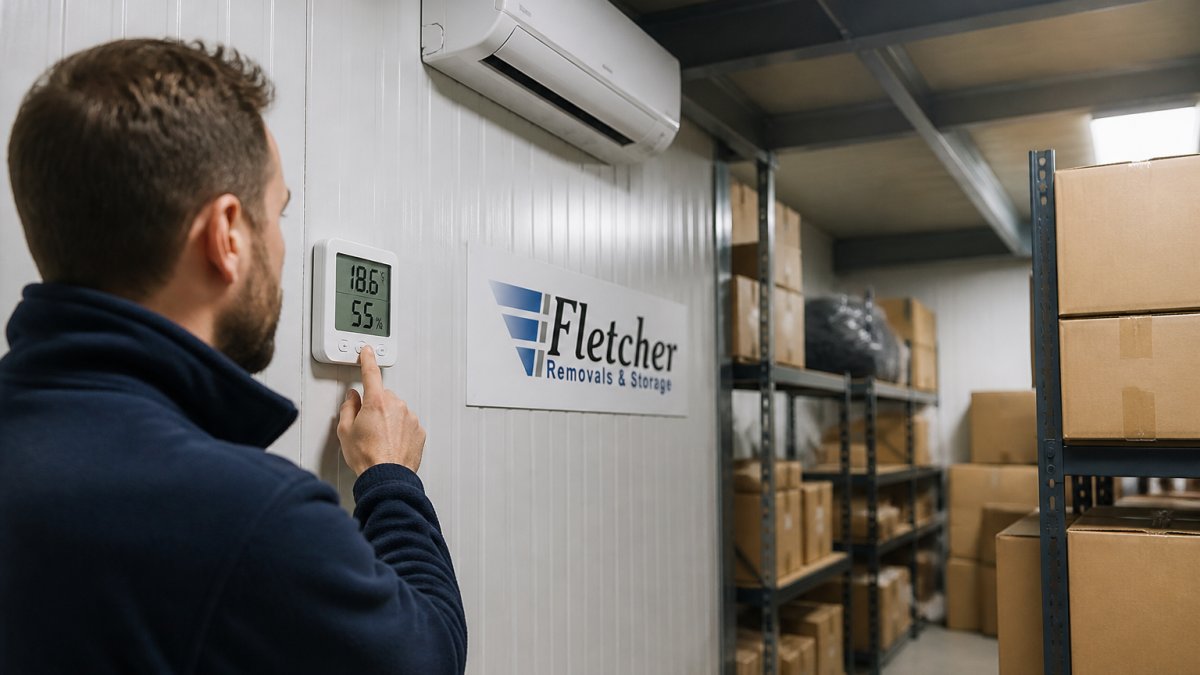
- Keep a small thermometer and humidity gauge in the unit
- Inspect the furthest corners monthly, not just the front
Packing and Positioning Your Inventory Correctly
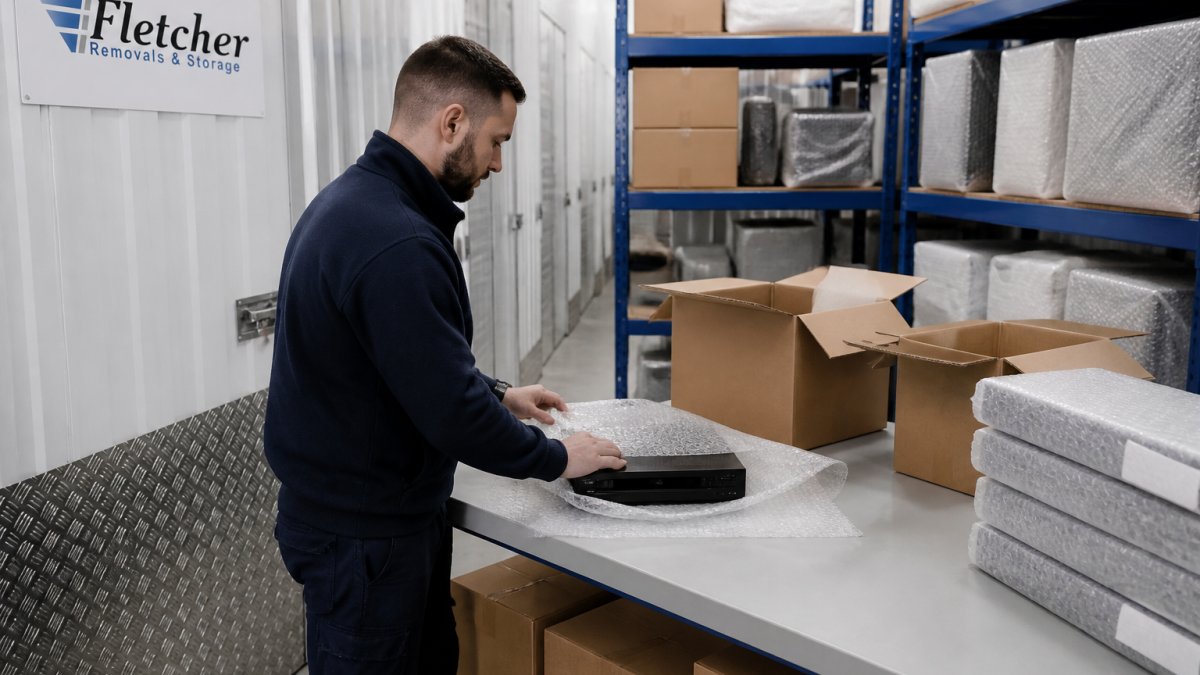
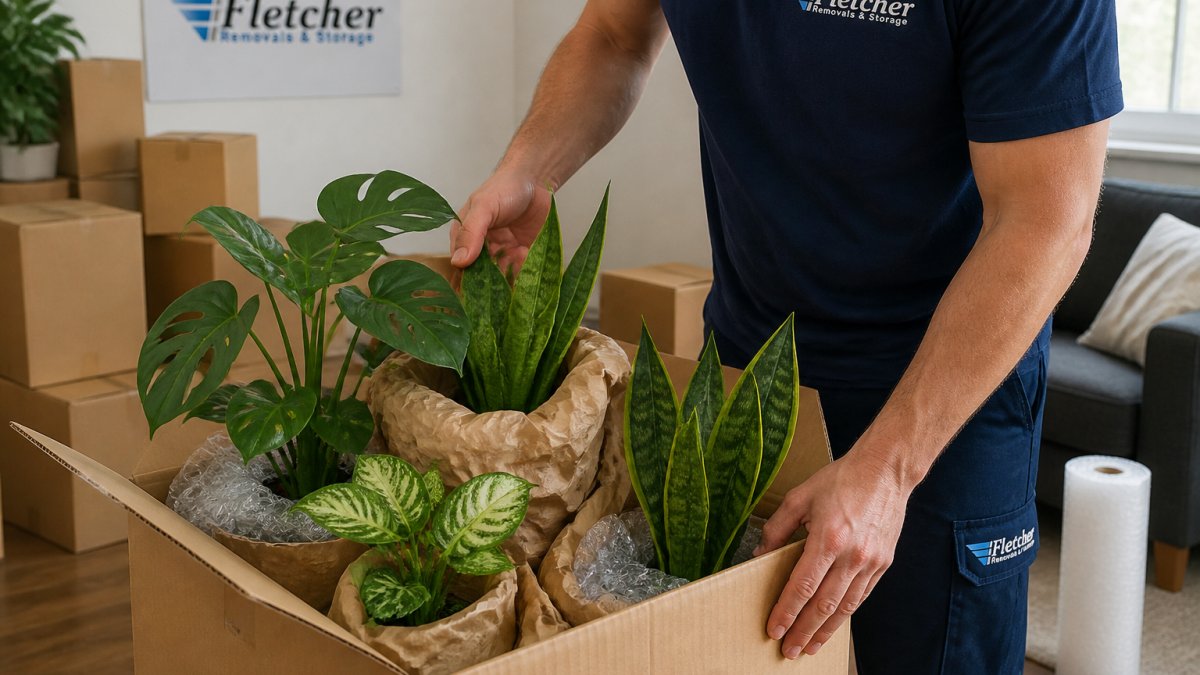
Packing decides how well stock survives. Use sealed plastic crates or lined boxes for anything porous. Add moisture absorbers to closed containers. Wrap metal items in acid-free tissue or greaseproof paper.
Position matters just as much. Heat rises and damp settles low, so the middle of the racking is the safest zone. Keep sensitive items there and put hardy goods at the top and bottom.
If you are moving stock between sites, ask how it will be handled in transit as well as in store.
What Temperature and Humidity Should Business Inventory Be Stored At
Most business inventory stores best between 15°C and 25°C, with relative humidity kept between 40% and 60%. These ranges suit paper, textiles, wood, electronics and most packaged goods.
Different stock has different limits, though:
| Stock Type | Ideal Temperature | Ideal Humidity | Main Risk |
|---|---|---|---|
| Paper and documents | 16-22°C | 40-55% | Mould, cockling |
| Textiles | 15-25°C | 45-55% | Damp, moths |
| Wooden furniture | 15-24°C | 45-60% | Warping, cracking |
| Electronics | 15-25°C | 40-55% | Condensation, corrosion |
| Leather goods | 15-25°C | 45-60% | Mould, drying |
| Food and drink | 10-21°C | 50-60% | Spoilage, pests |
Above 60% humidity, mould risk climbs quickly. Below 40%, wood and leather dry out and crack. Keep the range steady and you avoid both ends of the problem.
Is Climate-Controlled Storage Worth the Extra Cost for a Business
For most businesses holding sensitive stock, yes. The cost of controlled storage is usually far lower than the cost of replacing ruined goods, refunding customers and losing repeat trade.
Run the numbers on your own stock. Add up the value of one full bay, then ask what a total loss would cost you in stock, delivery delays and reputation. That figure is your real comparison point, not the weekly rate difference.
Controlled space pays off fastest when:
- Your stock is high value or hard to replace
- You hold goods for months rather than days
- Your unit is unheated or poorly insulated
- You store paper, textiles, electronics or food
- You cannot afford a stock-out during peak season
For short-term storage of hardy goods in mild months, ambient space can be the sensible choice. There is no shame in matching the unit to the job. Just do not put sensitive stock in ambient space and hope.
Pricing depends on the volume of goods, the length of stay and the access you need, so ask for a quote based on your actual load rather than a headline rate.
How to Tell Whether a Storage Unit Has Suitable Climate Control
You can check a unit in about ten minutes with three simple tests. Ask to visit in person, and go prepared.
- Ask for the recorded range: a good operator can show temperature and humidity logs
- Look for the kit: dehumidifiers, heaters, vents and insulation should be visible
- Check for damp signs: musty smells, stained walls, soft plaster or rust
- Test the feel: a controlled unit feels dry and even, not cold and clammy
- Ask about monitoring: who checks the readings, and how often
- Confirm insurance: ask what cover applies while goods are in store
A unit that cannot answer these questions is not controlled in any meaningful sense. Vague answers are your signal to walk away.
At Fletcher Removals and Storage, we have run secure onsite warehouse storage since 2013, with container and self-storage options and full Goods in Transit and Public Liability Insurance. Because we handle packing, moving and storage under one roof, your stock stays in the same careful hands from your old premises to the new one. You can see the Health and Safety Executive guidance on workplace temperatures for general benchmarks, and the British Standards Institution for standards on storage conditions. For broader context on how humidity affects stored materials, the Met Office explains humidity and its effects is a useful starting point.
Frequently Asked Questions
What is climate-controlled storage?
Climate-controlled storage keeps temperature and humidity within set limits, usually by heating, cooling, or dehumidifying the space. Unlike a standard unit that fluctuates with the weather, it maintains stable conditions year-round. For business inventory, this matters because materials like paper, textiles, electronics, and adhesives react badly to swings in moisture and heat. A properly controlled unit should be able to show you its temperature and humidity readings on request, and the best providers monitor these continuously rather than checking occasionally.
Which types of business stock need climate-controlled storage?
Items most at risk include paper goods, cardboard packaging, textiles, leather, wooden furniture, electronics, photographic equipment, pharmaceuticals, cosmetics, food products, and anything with adhesive labels or seals. If your stock contains natural fibres, electronic components, or water-based products, it belongs in climate-controlled storage. Even metal items can corrode in damp conditions. A simple test: if the item's packaging or material would be damaged by a spill or a hot car, it needs controlled conditions. When in doubt, ask your storage provider to assess your specific inventory.
Can damp or temperature changes damage stored stock?
Yes, and often invisibly at first. Damp causes mould, warping, rust, and delamination. Heat makes adhesives fail, plastics distort, and batteries degrade. Repeated temperature swings are worse than steady warmth because condensation forms inside packaging and on metal surfaces. By the time damage is visible, the stock is usually unsellable. Businesses storing cardboard boxes, printed materials, or electronics in an uncontrolled unit for several weeks often find the outer packaging has softened or labels have peeled, even if the product inside still looks fine.
Is climate-controlled storage worth the extra cost for a business?
It depends on what you're storing and for how long. For short-term storage of durable goods like metal tools or plastic containers, a standard unit may be fine. For anything sensitive, the cost of replacing damaged stock usually outweighs the extra storage fee. Consider the value of the inventory, how long it will be stored, and whether your insurance covers climate-related damage. Many policies exclude gradual deterioration, so a claim might not pay out. If your stock is high-value or you're storing for more than a few weeks, climate control is the safer choice.
Stock damage rarely announces itself. It builds quietly in damp corners and cold snaps until a customer opens a ruined box. If you are between premises, scaling up, or simply unsure whether your current unit is safe, Fletcher Removals and Storage can help. We offer secure onsite warehouse storage, professional packing and dismantling, and transparent pricing with no hidden fees. Get started with Fletcher Removals and Storage and keep your stock in condition worth selling.